
By Angela Gartner • Photography by Kim Stahnke
We highlight individuals and families who are inspiring others by sharing their experiences in the workplace, participating in fun and meaningful activities, and demonstrating how advocacy can create a more inclusive community for everyone.
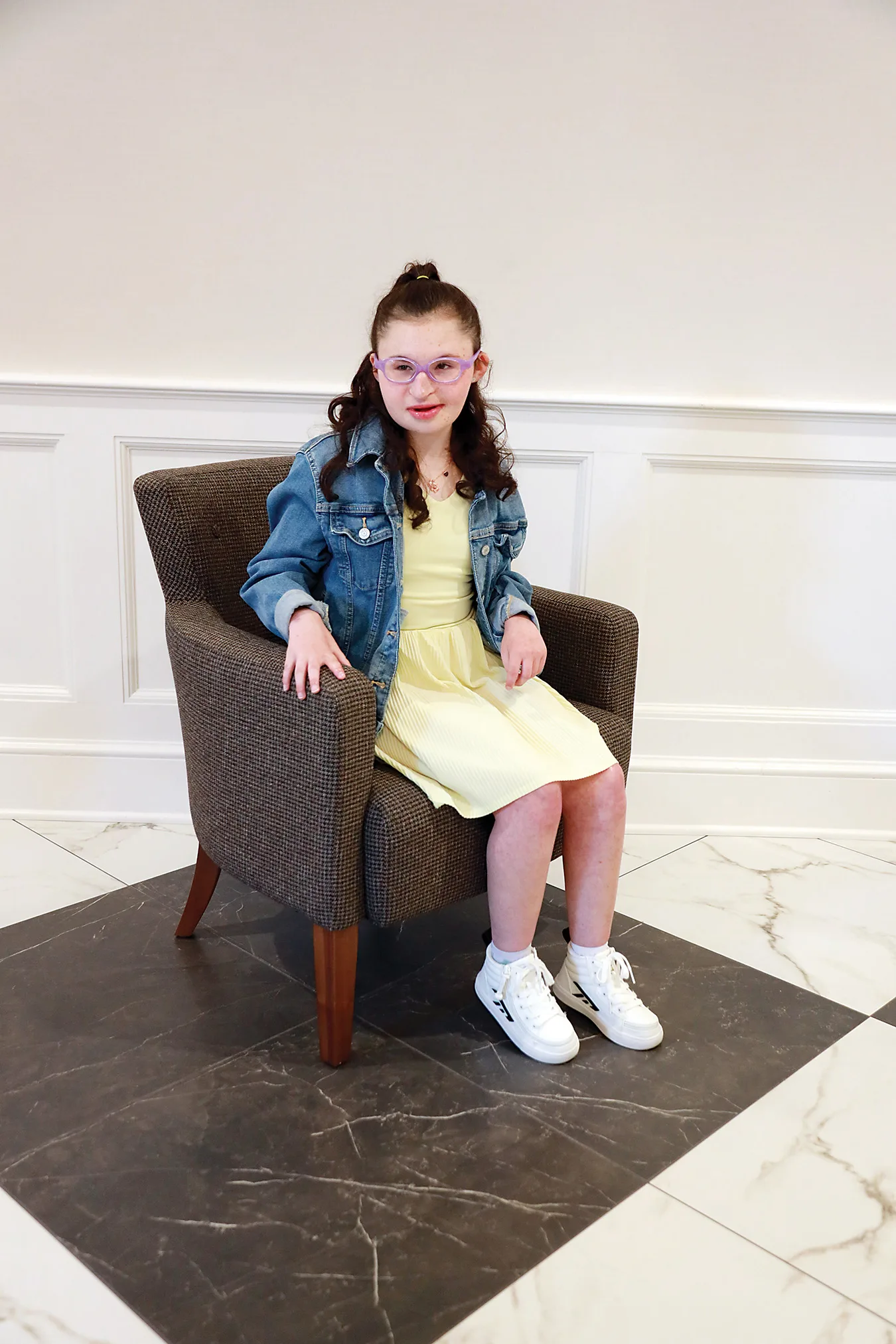
Finding Your Community — Alana Gohn
Alana Gohn, 17, of Solon, was initially diagnosed with
microcephaly as an infant, but there were still missing
pieces of Alana’s development that didn’t match
completely. It wasn’t until 2024 that she was diagnosed
with a rare neurodevelopmental disorder called HUWE1.
For the first time, her parents Scott Gohn and Elaine
Eisner, who helped to create LiveSpecial.com because they wanted to pull together resources since their daughter Alana was so unique, were able to connect to parents with children who had this diagnosis.
Due to the rarity of HUWE1, the support group,
which has families from the U.S. to the U.K., is still a small community.
“The scientific community finally caught up,” Gohn
says. “We were the early adopters in the group. We saw
the website initially, and then we found the Facebook
group and started interacting there. At the time when
we joined the Facebook group, she was the oldest one.”
He notes that since then, more have joined and they
have been able to see adults with HUWE1, which gives
Gohn and Eisner hope for Alana’s future. He notes in a community group, you see the challenges, but also the goals achieved.
“Finding a community is great, as you will no longer
feel that you are going at this alone,” he says. “However,
what we have found is that everyone is unique and no
two HUWE1 kiddos are the same. It’s a spectrum, some
individuals are high functioning and presenting as
typical individuals while others are low functioning and
requiring great assistance with all aspects of life. We see
and understand that there are individuals that may be
similar to Alana and who achieve goals.”
Gohn says as families who have children who are
newly diagnosed come to the group looking for answers,
he’s one of the first to respond.
“I respond simply because it’s comforting — to say
hey, it’s OK, you’re going to be OK,” he says. “From
that standpoint, I am the one getting the most out of
it because I am able to interact with individuals to say
here’s what the road may look like. So, maybe that is
giving me a little bit of therapy.”
For Gohn and Eisner, while the support group provides
a community aspect, it doesn’t change how they will
advocate for Alana.
“She is living her best life,” Gohn says. “She had a great
summer with camp. She enjoys school so much and it
provides a structure. She also gets the opportunity to
interact with her peers, which is fantastic for her.”
Alana doesn’t just go to school, but she is involved in
swimming, skiing and riding bikes.
“There’s a lot she continues to do and accelerate at,”
Gohn says. “Her accomplishments are at her own pace.
She gets what she needs, because Elaine and I advocate
for her at every single turn.”